New proof suggests Shireen Abu Akleh was killed in focused assault by Israeli forces
Warning: Undefined variable $post_id in /home/webpages/lima-city/booktips/wordpress_de-2022-03-17-33f52d/wp-content/themes/fast-press/single.php on line 26
2022-05-25 15:24:17
#proof #suggests #Shireen #Abu #Akleh #killed #targeted #attack #Israeli #forces
The cameraman filming the scene scrambles backwards to take cover behind a low concrete wall. Then a person cries out in Arabic: "Injured! Shireen, Shireen, oh man, Shireen! Ambulance!"
In the moments that comply with, a person in a white T-shirt makes a number of makes an attempt to maneuver Abu Akleh, however is compelled again repeatedly by gunfire. Lastly, after a number of lengthy minutes, he manages to pull her physique from the road.
The shaky video, filmed by Al Jazeera cameraman Majdi Banura, captures the scene when Abu Akleh, a 51-year-old Palestinian-American was killed by a bullet to the top at around 6:30 a.m. on Might 11. She had been standing with a group of journalists close to the entrance of Jenin refugee camp, the place that they had come to cover an Israeli raid. While the footage does not show Abu Akleh being shot, eyewitnesses informed CNN that they imagine Israeli forces on the identical road fired deliberately on the reporters in a targeted attack. The entire journalists have been sporting protective blue vests that recognized them as members of the news media.
"We stood in entrance of the Israeli military vehicles for about 5 to 10 minutes before we made moves to ensure they noticed us. And it is a behavior of ours as journalists, we move as a group and we stand in front of them so that they know we are journalists, after which we begin moving," Hanaysha told CNN, describing their cautious approach toward the Israeli army convoy, before the gunfire began.
When Abu Akleh was shot, Hanaysha said she was in shock. She could not perceive what was taking place. After Abu Akleh dropped to the bottom, Hanaysha thought she may need stumbled. But when she regarded down on the reporter she had idolized since childhood, it was clear she wasn't respiration. Blood was pooling under her head.
"As quickly as she [Shireen] fell, I honestly wasn't comprehending that she [was shot] ... I used to be hearing the sound of bullets, but I wasn't comprehending that they were coming at us. Honestly, the entire time I wasn't understanding," she mentioned.
"I assumed they have been taking pictures so we stayed back, I didn't assume they have been trying to kill us."
On the day of the capturing, Israeli military spokesperson Ran Kochav informed Army Radio that Abu Akleh had been "filming and working for a media outlet amidst armed Palestinians. They're armed with cameras, for those who'll allow me to say so," in line with The Occasions of Israel.
The Israeli army says it is not clear who fired the deadly shot. In a preliminary inquiry, the military said there was a chance Abu Akleh was hit both by indiscriminate Palestinian gunfire, or by an Israeli sniper positioned about 200 meters (about 656 toes) away in an trade of fireside with Palestinian gunmen — though neither Israel nor anyone else has supplied evidence exhibiting armed Palestinians within a transparent line of fireplace from Abu Akleh.The Israel Defense Forces (IDF) stated on May 19 that it had not yet determined whether or not to pursue a prison investigation into Abu Akleh's death. On Monday, the Israeli military's prime lawyer, Major General Yifat Tomer-Yerushalmi, mentioned in a speech that under the military's coverage, a legal investigation is just not mechanically launched if a person is killed in the "midst of an lively fight zone," until there's credible and speedy suspicion of a criminal offense. United States lawmakers, the United Nations and the international community have all known as for an unbiased probe.
However an investigation by CNN presents new evidence — including two movies of the scene of the capturing — that there was no lively combat, nor any Palestinian militants, close to Abu Akleh in the moments main as much as her death. Videos obtained by CNN, corroborated by testimony from eight eyewitnesses, an audio forensic analyst and an explosive weapons expert, recommend that Abu Akleh was shot lifeless in a targeted assault by Israeli forces.
The footage shows a calm scene earlier than the reporters came under fire within the outskirts of Jenin refugee camp, near the main Awdeh roundabout. Hanaysha, four different journalists and three local residents mentioned that it had been a standard morning in Jenin, house to about 345,000 folks — 11,400 of whom stay within the camp. Many were on their method to work or faculty, and the street was comparatively quiet.
There was a frisson of excitement because the veteran journalist, a household name throughout the Arab world for her protection of Israel and the Palestinian territories, arrived to report on the raid. About a dozen or so men, some wearing sweats and flip-flops, had gathered to observe Abu Akleh and her colleagues at work. They have been milling round chatting, some smoking cigarettes, others filming the scene on their telephones.
In a single 16-minute cellphone video shared with CNN, the person filming walks towards the spot where the journalists had gathered, zooming in on the Israeli armored autos parked in the distance, and says: "Look at the snipers." Then, when a teenager friends tentatively up the street, he shouts: "Don't kid around ... you suppose it is a joke? We don't wish to die. We want to reside."
Israeli raids on the Jenin refugee camp have turn into an everyday incidence since early April, in the wake of a number of assaults by Palestinians that left Israelis and foreigners lifeless. A few of the suspected assailants of these assaults had been from Jenin, in accordance with the Israeli military. Residents say the raids usually lead to injuries and deaths. On Saturday, a 17-year-old Palestinian was killed and an 18-year-old was critically injured by Israeli hearth throughout a raid, the Palestinian Ministry of Health mentioned.Salim Awad, the 27-year-old Jenin camp resident who filmed the 16-minute video, informed CNN that there were no armed Palestinians or any clashes within the space, and he hadn't expected there to be gunfire, given the presence of journalists nearby.
"There was no conflict or confrontations at all. We were about 10 guys, give or take, walking around, laughing and joking with the journalists," he stated. "We weren't afraid of anything. We didn't expect anything would happen, as a result of once we saw journalists round, we thought it'd be a protected space."
However the state of affairs changed quickly. Awad said shooting broke out about seven minutes after he arrived on the scene. His video captures the moment that photographs had been fired at the 4 journalists — Abu Akleh, Hanaysha, another Palestinian journalist, Mujahid al-Saadi, and Al Jazeera producer Ali al-Samoudi, who was injured in the gunfire — as they walked toward the Israeli autos. In the footage, Abu Akleh can be seen turning away from the barrage. The footage reveals a direct line of sight towards the Israeli convoy.
"We noticed around 4 or 5 army vehicles on that avenue with rifles protruding of them and one among them shot Shireen. We were standing right there, we saw it. When we tried to strategy her, they shot at us. I tried to cross the road to assist, but I could not," Awad mentioned, adding that he saw that a bullet struck Abu Akleh in the hole between her helmet and protective vest, just by her ear.
A 16-year-old, who was among the many group of men and boys on the road, told CNN that there were "no photographs fired, no stone throwing, nothing," before Abu Akleh was shot. He stated that the journalists had informed them not to observe as they walked toward Israeli forces, so he stayed back. When the gunfire broke out, he stated he ducked behind a automobile on the street, three meters away, where he watched the moment she was killed. The teenager shared a video with CNN, filmed at 6:36 a.m., just after the journalists left the scene for the hospital, which confirmed the 5 Israeli military autos driving slowly past the spot where Abu Akleh died. The convoy then turns left before leaving the camp via the roundabout.
CNN reviewed a total of 11 movies displaying the scene and the Israeli army convoy from different angles — before, during and after Abu Akleh was killed. Eyewitnesses who had been filming when the journalist was shot were also within the line of fire and pulled again when the gunfire began, so do not capture the moment she is hit with the bullet.
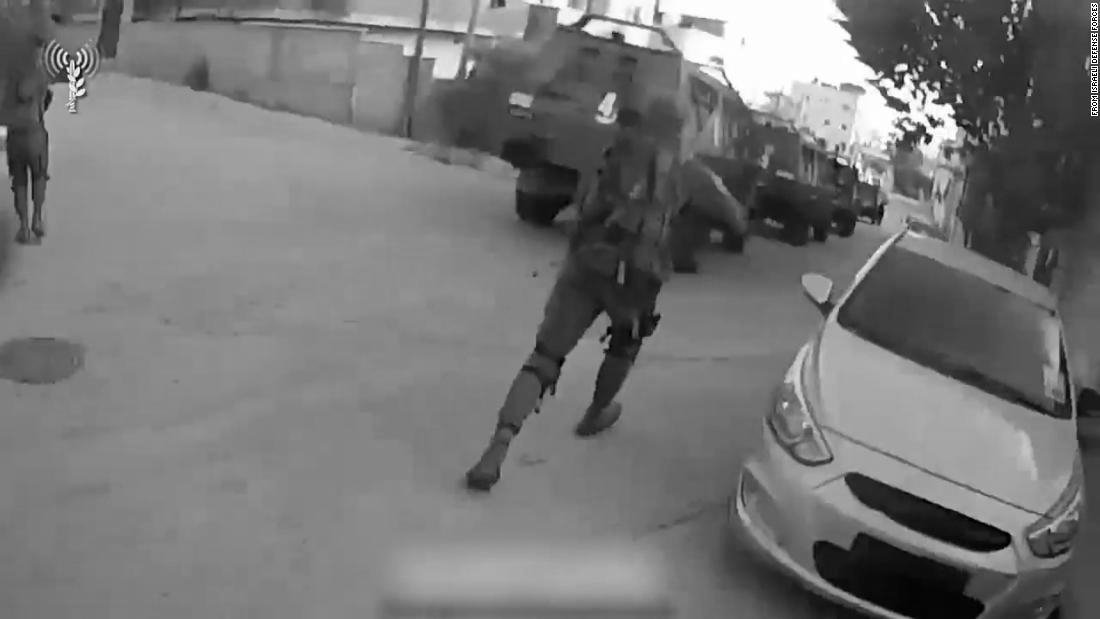
The visible proof reviewed by CNN includes a physique camera video released by the Israeli navy, which captures soldiers working via a narrow alleyway, holding M16 assault rifles, and variants, as they spill out onto the road where the armored automobiles are parked. An Israeli military source informed CNN that each side have been firing M16 and M4 style assault rifles that day.
Within the videos, five Israeli vehicles could be seen lined up in a row on the identical street where Abu Akleh was killed, to the south. The automobile closest to the journalists, emblazoned with a white number one, and the automobile furthest away, marked with the quantity 5, are each positioned perpendicular across the road. Toward the rear of the autos, immediately above the numbers, is a slender rectangular opening within the exterior of the car.
The Israeli army referenced such an opening in an announcement about its initial investigation into Abu Akleh's capturing, saying that the journalist could have been hit by an Israeli soldier shooting from a "designated firing hole in an IDF car utilizing a telescopic scope," throughout an exchange of fireplace. A number of eyewitnesses told CNN that they saw sniper rifles protruding of the openings before the capturing started, however that it was not preceded by some other gunfire.
Jamal Huwail, a professor on the Arab American University in Jenin, who helped drag Abu Akleh's lifeless physique from the street, stated he believed the pictures have been coming from one of the Israeli vehicles, which he described as a "new mannequin which had a gap for snipers," due to the elevation and route of the bullets.
"They were taking pictures instantly at the journalists," Huwail stated.
Huwail, a former parliamentarian and member of the Palestinian Fatah Occasion in Jenin, first met Abu Akleh two decades in the past, when Israel launched a major navy operation within the camp, destroying greater than 400 houses and displacing 1 / 4 of its inhabitants. When he spoke with the journalist briefly that morning of May 11 on the Awdeh roundabout, she had showed him a video of one in every of their early interviews from 2002. The following time he saw her up close, she was dead.
In movies of the daybreak army raid on Jenin camp earlier within the morning, Israeli troopers and Palestinian militants can be seen battling each other with M16 assault rifles and variants, based on Chris Cobb-Smith, an explosive weapons knowledgeable. Meaning both sides would have been taking pictures 5.56-millimeter bullets. To trace the bullet that killed Abu Akleh to the barrel of a selected gun would likely require a joint Israeli-Palestinian probe, for the reason that Palestinians have the bullet that killed Abu Akleh, whereas CNN's investigation suggests the Israelis have the gun. None is straight away forthcoming. While Israel weighs whether to launch a legal investigation, the Palestinian Authority has ruled out collaborating with the Israelis on any investigation.
A senior Israeli safety official flatly denied to CNN on May 18 that Israeli troops killed Abu Akleh intentionally. The official spoke below the situation of anonymity to discuss particulars about an investigation that is still formally open.
"Under no circumstances would the IDF ever target a civilian, particularly a member of the press," the official instructed CNN.
"An IDF soldier would never fireplace an M16 on computerized. They shoot bullet by bullet," the official mentioned, in contrast with Israel's assertion that Palestinian militants had been firing "recklessly and indiscriminately" while its troopers carried out the raid in Jenin.
In an announcement emailed to CNN, the IDF mentioned it was conducting an investigation into the killing of Abu Akleh. It "calls on the Palestinian Authority to cooperate with a joint forensic examination with American representatives to conclusively decide the supply of the tragic dying."
And added, "assertions relating to the source of the fireplace that killed Ms. Abu Akleh should be fastidiously made and backed by onerous proof. That is what the IDF is striving to realize."
Even with out access to the bullet that hit Abu Akleh, there are methods to determine who killed Abu Akleh by analyzing the type of gunfire, the sound of the photographs and the marks left by the bullets at the scene.
Cobb-Smith, a safety consultant and British military veteran, told CNN he believed Abu Akleh was killed in discrete shots — not a burst of automated gunfire. To succeed in that conclusion, he looked at imagery obtained by CNN, which present markings the bullets left on the tree the place Abu Akleh fell and Hanaysha was taking cover.
"The number of strike marks on the tree where Shireen was standing proves this wasn't a random shot, she was targeted," Cobb-Smith informed CNN, adding that, in sharp distinction, the vast majority of gunfire from Palestinians captured on digicam that day were "random sprays."
As proof, he pointed to two movies that showed Palestinian gunmen firing haphazardly down alleyways in different components of Jenin. The movies had been circulated by the workplace of Israeli prime minister, Naftali Bennett, and Israel's overseas ministry, with a voiceover in Arabic saying: "They've hit one — they've hit a soldier. He's mendacity on the bottom."Because no Israeli soldiers had been reported killed on May 11, Bennett's office mentioned the video prompt that "Palestinian terrorists had been those who shot the journalist." CNN geolocated the movies shared by Bennett's workplace to the south of the camp, more than 300 meters, or 1,000 toes, away from Abu Akleh. The coordinates of the two places, which were verified using Mapillary, a crowdsourced street imagery platform, and photographs of the realm filmed by Israeli human rights group B'Tselem, exhibit that the taking pictures in the videos could not be the same volley of gunfire that hit Abu Akleh and her producer, Ali al-Samoudi. CNN was also unable to verify independently when the footage was filmed.
Based on the Israeli military's preliminary inquiry, at the time of Abu Akleh's loss of life, an Israeli sniper was 200 meters away from her. CNN requested Robert Maher, professor of electrical and computer engineering at Montana State University, who specializes in forensic audio analysis, to evaluate the footage of Abu Akleh's shooting and estimate the distance between the gunman and the cameraman, considering the rifle being utilized by the Israeli forces.
The video that Maher analyzed captures two volleys of gunfire; eyewitnesses say Abu Akleh was hit within the second barrage, a collection of seven sharp "cracks." The primary "crack" sound, the ballistic shockwave of the bullet, is followed approximately 309 milliseconds later by the relatively quiet "bang" of the muzzle blast, in accordance with Maher. "That might correspond to a distance of one thing between 177 and 197 meters," or 580 and 646 toes, he stated in an e-mail to CNN, which corresponds nearly precisely with the Israeli sniper's place.
At 200 meters, Cobb-Smith stated that there was "no likelihood" that random firing would end in three or 4 photographs hitting in such a good configuration. "From the strike marks on the tree, it seems that the photographs, one of which hit Shireen, got here from down the street from the direction of the IDF troops. The relatively tight grouping of the rounds point out Shireen was intentionally targeted with aimed shots and never the victim of random or stray hearth," the firearms knowledgeable instructed CNN.
The tree is now referred to in Jenin as the "journalist tree" and has turn into a makeshift shrine to Abu Akleh, with photographs of the beloved reporter taped to the trunk and Palestinian kaffiyeh scarves draped from its branches.
Awad, one of the Jenin residents who inadvertently captured Abu Akleh's killing on digicam, stated the primary time he noticed her in particular person was in 2002, when she was overlaying the Intifada, or uprising, in Jenin. "She is of course beloved by so many, however she has a very particular reminiscence in our camp specifically because of the work she has carried out right here. The people listed here are very sad for her loss," he stated.
Last month, Abu Akleh celebrated her birthday in Jenin, when she was there to cowl an Israeli miltary raid, her longtime colleague, cameraman Majdi Banura, recalled. Banura and Abu Akleh began at Al Jazeera on the same day 25 years in the past, and spent much of their careers out within the area collectively.
Banura continues to be reeling from having seen Abu Akleh, whom he had filmed numerous occasions earlier than, die in entrance of his own eyes. But when the gunfire broke out, he knew he had to proceed rolling, saying that it was vital to have a "steady report" of her killing.
"To be sincere, as I was filming, I had hoped that she might be alive, however I knew seeing her immobile she had been killed," Banura stated.
"Her image would not depart my life and reminiscence, every part I say or do or touch, I see her."
CNN's Eliza Waterproof coat in London wrote and reported. Zeena Saifi reported from Abu Dhabi, Celine Alkhaldi from Amman and Kareem Khadder from Jerusalem. Katie Polglase and Gianluca Mezzofiore reported from London. Richard Allen Greene, Abeer Salman, Hadas Gold and Atika Shubert contributed to this report. Design and visual enhancing by Natalie Croker and Henrik Pettersson
Quelle: www.cnn.com